Name order and surnames around the world: a practical guide
A name order and surname guide has to start with an uncomfortable fact: "first name, last name" is a Western habit, not a law of nature. Many people write the family name first, carry two surnames, change the surname ending by gender, or have no family name at all. Writers who ignore this produce characters that feel wrong to anyone from the culture, and developers who ignore it ship forms that reject real customers.
Everything below follows the W3C Internationalization guidance on personal names around the world, which is the reference I trust for the basics. I add the practical consequences for fiction and for software.
Family name first: East Asia and Hungary
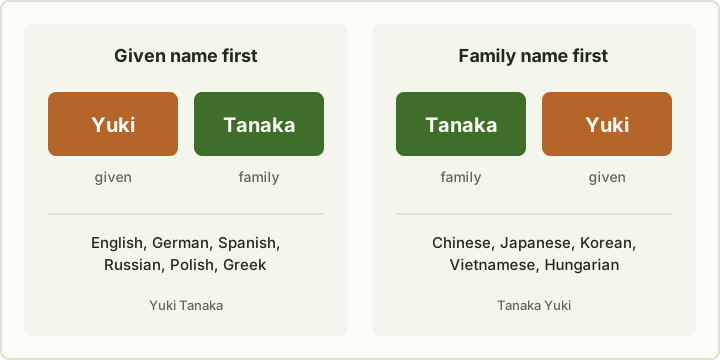
Chinese, Japanese, Korean, Vietnamese and Hungarian names are written family name first. The W3C example is Mao Ze Dong: the family name is Mao, and Ze Dong is the given name. In a Japanese setting, Tanaka Yuki is a person called Yuki from the Tanaka family.
In English-language writing you will see both orders. Many people from these cultures reverse their names when writing in English, and many do not. For fiction, I use this rule: follow the order a character would use in the setting of the scene. In a Tokyo office, Tanaka Yuki. In an international school email thread, possibly Yuki Tanaka. Tell the reader once and stay consistent.
The generator has a native-order option for Chinese, Japanese, Korean and Vietnamese. Leave it on when you want names that look as they would in their own country; switch it off to get the given-first order that English text expects. These four origins get no Western middle name, and the card says so. A small hint on the result card tells you which order you are looking at.
Two surnames: Spanish and Brazilian names
Spanish speakers usually carry two surnames: the paternal one first, then the maternal one. The W3C example is María José Carreño Quiñones, daughter of Antonio Carreño Rodríguez and María Quiñones Marqués. Her first surname comes from her father's first surname, her second from her mother's first surname.
In Brazil the usual order is reversed: maternal surname, then paternal. So a Brazilian João whose mother's family is Costa and whose father's family is Silva is João Costa Silva, and Silva is the family line that passes on. Both are conventions, not rules for every person, but they are the right default for a believable character.
| Culture | Order | Example | Which surname is which |
|---|---|---|---|
| Spanish | Given, paternal, maternal | María García López | García is the father's, López the mother's |
| Brazilian Portuguese | Given, maternal, paternal | João Costa Silva | Costa is the mother's, Silva the father's |
The tool's double-surname option works for the Spanish and Portuguese origins only (Portuguese follows the Brazilian order), and it always makes the two surnames different.
Surnames that change with gender
In Russian, Polish and Greek, a woman usually carries the feminine form of the family surname. The W3C gives a Russian pair: Boris Nikolayevich Yeltsin and Naina Iosifovna Yeltsina. The man's surname is Yeltsin; the wife's is Yeltsina.
| Language | Rule | Male form | Female form |
|---|---|---|---|
| Russian | -ov, -ev, -in, -yn add -a | Ivanov | Ivanova |
| Russian | -yov becomes -yova | Solovyov | Solovyova |
| Russian | -sky and -skiy become -skaya | Gorodetsky | Gorodetskaya |
| Polish | -ski becomes -ska, -cki becomes -cka, -dzki becomes -dzka | Kowalski | Kowalska |
| Polish | other endings stay | Nowak | Nowak |
| Greek | -os becomes -ou | Papadopoulos | Papadopoulou |
| Greek | -is becomes -i | Papadakis | Papadaki |
| Greek | -ou stays | Georgiou | Georgiou |
These are the common patterns, and the generator applies them when you choose a female name in those origins; Greek -as loses its s as well (-as becomes -a). If you already have a family name, type it into the Baby tab: with a Russian, Polish or Greek origin selected, girls get the feminine form of it. Not every surname follows the patterns: Slavic surnames in -enko or -chuk, for example, do not change. When an unusual surname matters to your plot, check it with a native speaker.
The mistake I see most often is "Anastasia Ivanov" or "Agnieszka Kowalski" in a book set in Moscow or Warsaw. It is exactly the kind of slip that tells a native reader the author did not look.
Patronymics: names that say whose child you are
A patronymic builds part of the name from the father's given name. Three systems matter for writers:
- Russian. The middle name is a patronymic: Nikolayevich means "son of Nikolay", Iosifovna means "daughter of Iosif". Formal address uses given name plus patronymic.
- Icelandic. The "surname" is a patronymic: -son for a son, -dóttir for a daughter. Björk Guðmundsdóttir is the daughter of Guðmundur. Siblings of different genders therefore have different last names, and a mother and daughter do too.
- Malay. The word bin means "son of" and binti means "daughter of", placed between the given name and the father's name.
The tool does not generate Icelandic or Malay names; it is useful to know them so you do not write "the Guðmundsdóttir family" as if it were an inherited surname.
People with one name
Many people, for example in parts of southern India, Malaysia and Indonesia, have a given name only. Do not give them a family name for the sake of tidiness. In fiction, a single-name character is realistic and memorable. In software, it is a requirement.
What this means for your forms and your fiction
| If you are writing | Do this | Avoid |
|---|---|---|
| A novel or script | Match order, surname form and double surnames to the setting | Western order and masculine surnames for every character |
| A sign-up form | One "full name" field, or given name and family name that can each be empty | Requiring both a first and last name |
| A greeting email | Store which part is the name to address | Assuming the first word is the given name |
| A sort order | Keep the family name as its own field when you need it | Splitting a string on the first space |
Names with apostrophes, spaces and diacritics are also the best test cases for software. The next guide covers them: safe fake names, emails and phone numbers for test data and fiction. If you are naming a cast, go back to how to name a character for the checklist.
To try these rules, open the random name generator, choose an origin, set the gender and look at the small hint on each card: it says when an order or a surname rule was applied.
Frequently asked
Which countries put the family name first?
Chinese, Japanese, Korean, Vietnamese and Hungarian names are written family name first. In English text, people from these cultures sometimes reverse the order, so decide which one your text follows and stay consistent.
Why do Spanish people have two last names?
They carry the father's first surname followed by the mother's first surname. In Brazil the usual order is the mother's surname first, then the father's.
Why do Russian women's surnames end in -a?
Russian surnames change with gender: Ivanov becomes Ivanova, and Yeltsin becomes Yeltsina. Polish (Kowalski, Kowalska) and Greek (Papadopoulos, Papadopoulou) work in a similar way.
Does everyone have a family name?
No. Many people, for example in parts of southern India, Malaysia and Indonesia, have only a given name, so forms should not require both.