How to name a character: a checklist for names that stick

Read your cast list aloud before you commit to it. If three of five names start with the same letter and have the same rhythm, your readers will blur them, and no amount of clever backstory fixes that. To name a character well, you need a name that fits the world and stays distinct from everyone else on the page.
I work through the same sequence every time, whether the name is for a novel, a screenplay or an NPC I need in ten seconds at the table: origin first, then contrast inside the cast, then sound with the surname, then a last check for accidents. The random name generator covers most of the mechanical part; the judgement is yours.
Name a character for the household, not the country
Choose the origin of the character's family, then of the place. A story set in a large modern city can have a Nigerian-born doctor, a third-generation Polish baker and a Korean exchange student, and each name should carry its own culture's shape. Setting fixes the pool; family history picks from it.
Three practical points save you from the most common slips:
- Surnames change with gender in some languages. A Russian woman in your book is Ivanova, not Ivanov; a Polish woman is Kowalska, not Kowalski. The generator applies these forms for you. The reasons are in name order and surnames around the world.
- Order is not universal. Chinese, Japanese, Korean and Vietnamese names are written family name first. Decide whether your narration follows the native order or the Western one, and keep it consistent.
- Generation matters more than most writers think. Names rise and fall in fashion. When the character is a grandmother, pick a name from her generation's pool, not from a baby-name list of today.
Make every main name easy to tell apart
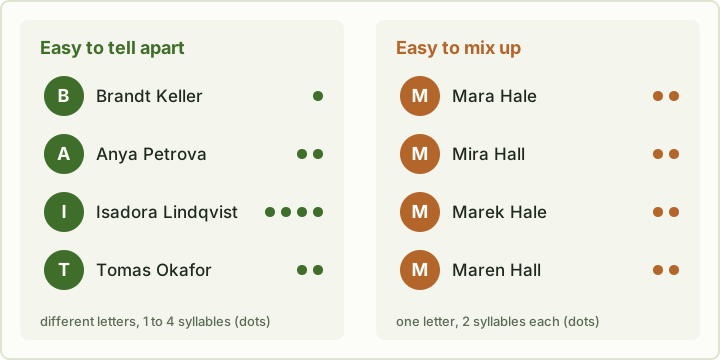
This is the check I never skip. Readers recognise a name by its shape long before they read it letter by letter: the first letter, the length and the rhythm. Give each main character a different shape.
| Check | Rule I use | Fails when |
|---|---|---|
| First letter | Different for every main character | Mara, Mira, Marek, Maren |
| Length | Mix short and long first names | Every name is five letters |
| Syllables | Mix 1, 2 and 3 or more | Every name is two syllables |
| Ending sound | Avoid three names ending in -a or -en | Anya, Cora, Mara, Lena |
| Surnames | Different first letter and length too | Hale and Hall in one scene |
A cast that passes: Brandt Keller (one syllable first name), Anya Petrova, Isadora Lindqvist, Tomas Okafor. Four initials, first names of 6, 4, 7 and 5 letters, 1 to 4 syllables. You can tell them apart in a crowded scene without a single tag line.
For minor characters the rule relaxes, but not completely. Two minor characters sharing a name with a main one is the classic trap. If your hero is Tomas, nobody else in the book gets a name starting with To.
Say the full name aloud
A first name that looks good alone can fail next to its surname. Read the full name twice, at normal speed, and listen for these:
- Collisions at the join. A first name ending in the sound the surname starts with ("Tomas Samson") runs together.
- Rhyme and echo. First and last names that rhyme or repeat a syllable sound like a nursery rhyme or a stage name. That is fine for a comedy sidekick and a problem for a detective.
- Stress pattern. A three-syllable first name with a one-syllable surname (Isadora Hale) has a falling rhythm that suits a formal character. One plus one (Wren Hale) sounds clipped and fast. Match the rhythm to the temperament.
- Tongue-twisters. If you stumble reading it, so will an audiobook narrator.
The generator shows letters and syllables for each result and lets you filter by starting letter, maximum length (4 to 10 letters) and syllable count (1, 2, 3 or 4+), which makes it easy to hunt for the short one-syllable name that your cast is missing. The syllable count is an estimate from vowel groups, so it separates Jane from Isabella well and still deserves a read aloud.
Check the initials before you fall in love
Initials turn up on monograms, signatures, email addresses, school bags and in a villain's note. A first, middle and last name can accidentally spell a word. Adam Samuel Smith is ASS. Peter Ian Green is PIG. Neither is a disaster in a comedy, but in a serious scene it pulls the reader out.
The shortlist in the tool shows initials and a monogram, and flags initials that spell any of sixteen short words, such as ASS, PIG, BAD, DIE, FAT, MAD, RAT, SAD, SOS, WTF or ZIT. Emma Rose Clark gives ERC and passes. Do the same check by hand if you build names offline.
Nicknames, titles and the name on the page
Pick one name that the narration uses and stick to it. A character called Isadora by the narrator, Izzy by her friends and Ms Lindqvist by her students is believable in life and exhausting on the page, unless each version signals a relationship. Use the variants deliberately: the nickname appears only in dialogue from people who love her, and the formal form appears only when someone wants distance.
Check that a nickname does not collide with another character's name. "Izzy" is fine until a secondary character is called Isabel.
Meaning, famous names and walk-ons
A meaningful name is a bonus, not a requirement. Readers rarely look up etymology, and a name that screams its meaning (a baker named Baker, a brave soldier whose name means "bold") reads as a wink at the audience. Use meaning for yourself, as a private anchor, and let the sound do the work for the reader.
Avoid names that already belong to a famous character in your genre. Names themselves are not owned, but a reader who sees one will think of the original and not of yours. The fantasy tab blocks well-known canon names for that reason.
For walk-on characters, speed matters more than perfection. A clerk who appears once needs a plain, believable name that does not draw attention: generate five, take the first that does not clash with the cast, move on.
A quick workflow with the generator
- Pick the origin and gender for the character, or choose unisex only if the name must work for anyone.
- Set the filters that your cast needs: starting letter not already used, maximum length, and a syllable count that is missing from the cast.
- Generate a batch of 20. The tool draws without repeats and tells you how many combinations match your filters. If one name is wrong, the ↻ button on its card swaps only that name.
- Star three to five names into the shortlist. Do not decide yet.
- Read each shortlisted full name aloud with its surname, then check the initials and the cast-contrast table above.
- Copy the shortlist or export it as TXT or Excel-safe CSV and keep it with your character notes. It stays in this browser unless you export it.
If the same cast list will also feed a mock-up or a database fixture, read safe fake names, emails and phone numbers before copying anything into a live system.
Frequently asked
How do I stop my characters' names from sounding alike?
Give each main character a different first letter, a different length and a different number of syllables, and do the same check for surnames. Read the cast list aloud; if two names blur, change one.
Should a character's name have a meaning?
It can, but it is a bonus. Readers respond to sound and fit first, so choose for the setting and the rhythm, and treat meaning as a private anchor.
Can I use a name from a generator in my book?
Yes. Names are not owned, but avoid names that already belong to a famous character in your genre, because readers will think of the original.
How do I check that initials do not spell something rude?
Write the first, middle and last initials together and read them as a word. The shortlist in the generator flags combinations such as ASS, PIG, BAD or SOS for you.